A city name generator for places that sound founded
Cities, towns, villages, ports and holds, each with a note on what the name implies happened there. The nicknames group is what the locals call it, usually unkindly.
A city name generator suggests names for settlements in fiction. This one covers cities, towns, villages, ports, fortresses and the nicknames locals use, each with a note on the history the name implies. Browsing is free and needs no account. Names built from your own description of a place use a free account with 15 free credits.
City and town name generator
Places
- Pilot Coveyou do not enter without one
- Foundlingsgrew around an orphanage
- Kettlebridgea bridge shaped like a handle
- Blackwatcha garrison that outlived its war
- Vellmarka boundary that became a capital
- Mudgelyexactly as promised
- Sentinel Rocka crag with one road up
- Tessalineplanned, symmetrical, faintly inhuman
- Nettlebedthe one crop nobody planted
- Thornwalla hedge fortification, then a stone one
- Ostreya port that silted up and stayed rich
- Sheepwashan activity, not a place, until it was
- Stonewatchplain name, brutal history
- Marnholda fortress the city grew around
- Windlea winding way
- Bulwarka word, used as a name
- Dunmoraya hill fort turned bureaucracy
- Ramsdipsheep country, a sheltered fold
- The Redoubtthey stopped naming it properly
- Orrinone syllable, very old, unexplained
- Stitchcombea narrow valley, one trade
- Oathkeepbuilt to honor a treaty nobody kept
- Salt Antonya saint and an industry
- Kestrel Baysheltered and hard to blockade
Or describe the place
Settlement type, region and era in, ten names out, each with what it implies.
0 / 2000
Place names are history in two syllables
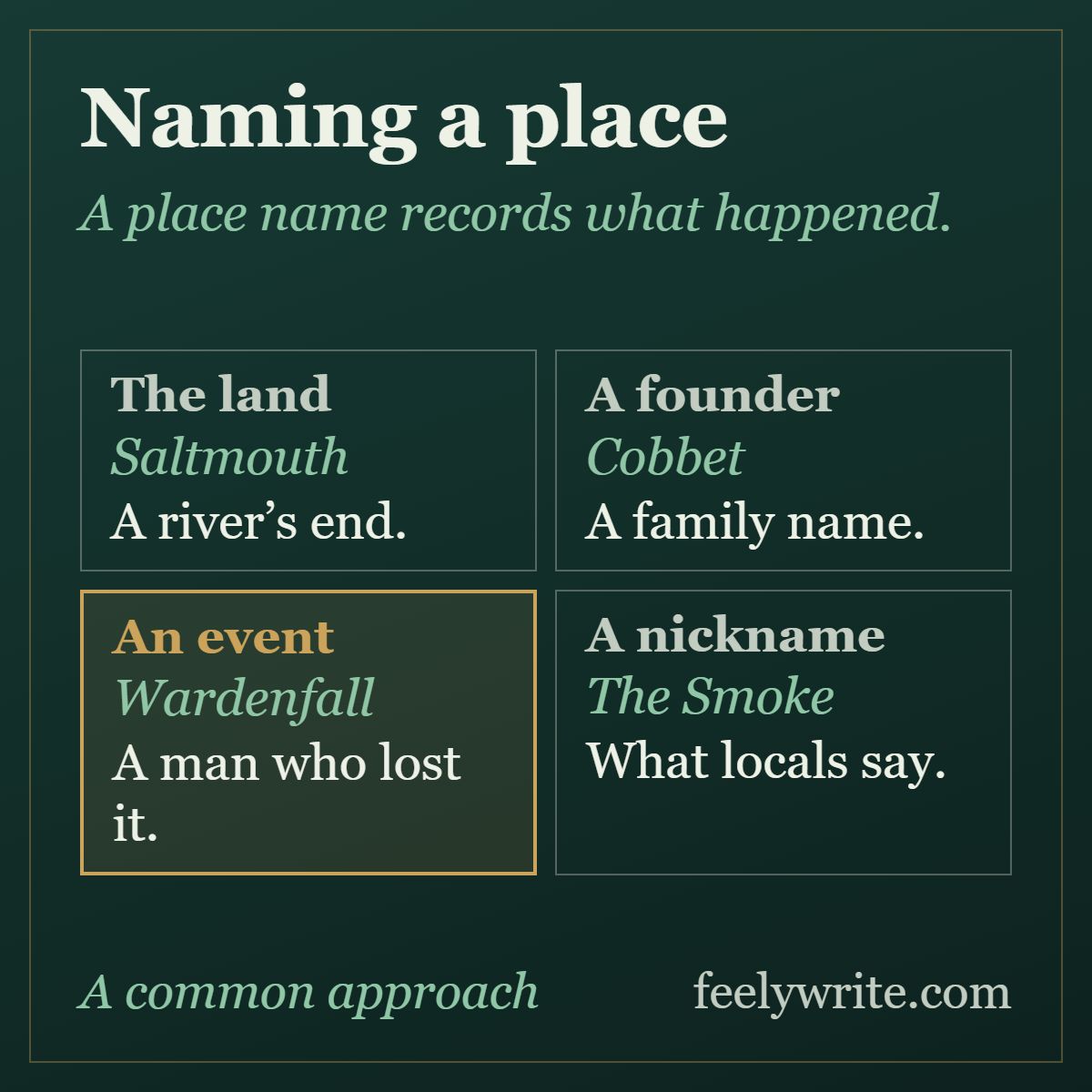
Real place names are almost never decorative. They record a ford, a market, a family, a burned church, a tree that is no longer there. Lantern Cross is four roads, lit all night. Pale Harrow is a plague city that recovered. The name arrives carrying a century of story you never have to write down.
That is the thing to borrow. A settlement called Sweetwater was founded by people who found water. A settlement called Harrowgate was founded by people who did not. Pick a name that implies the wrong thing and readers feel the mismatch even when they cannot say why.
How to use this city name generator
Start with the size of the place. The lists run from cities and towns down to villages, then across to ports and harbors and to fortresses and holds. A last group holds the nicknames locals use. Read the note beside each name: it is a one-line history. The history is what makes a name usable. Then pair an official name with a nickname, because every real city has both.
Reroll for new names as often as you like. If you need names for one specific place, describe it instead: its size, its trade, who founded it and what went wrong. The generator returns ten names built around that description. That run needs a free FeelyWrite account.
What the endings on real town names mean
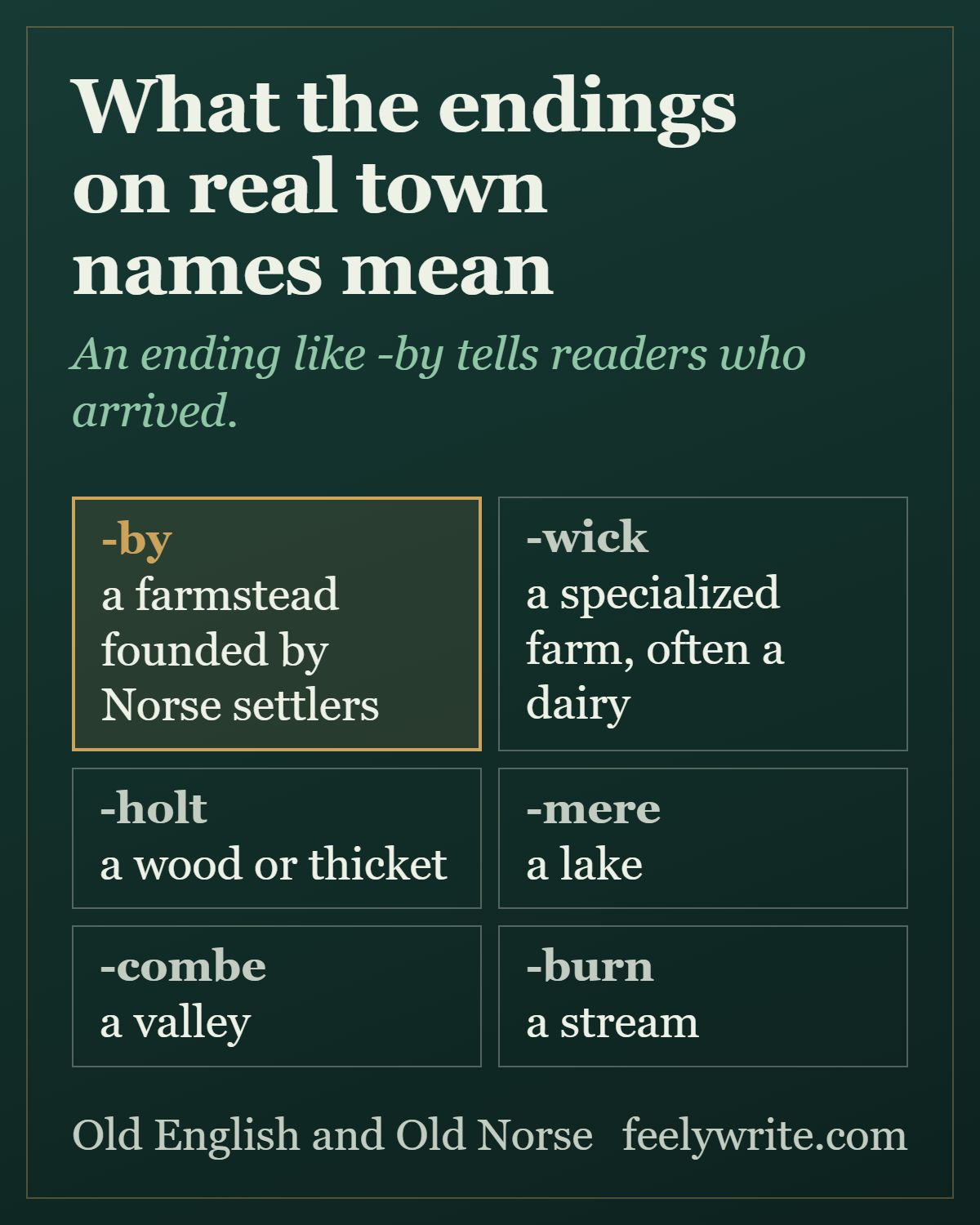
English place names are built from old words, most of them Old English and Old Norse. A few of the endings are worth knowing. The ending -by marks a farmstead founded by Norse settlers, which is why so many cluster in the north and east of England. Thornaby began as the farm of a man named Thormod. The other common endings describe what was already there rather than who arrived: -wick was a specialized farm, often a dairy; -holt a wood or thicket; -mere a lake; -combe a valley; and -burn a stream.
That split is useful. An ending like -by tells readers who arrived. Endings like -mere and -holt tell them what was already there. A fictional map can use both kinds of signal on purpose.
Name it for what happened, not what it looks like
Founders name places after events, resources and people, very rarely after scenery. A town called Kettlebridge has a bridge shaped like a handle. A town called Beautiful Valley has an author, not a history.
Give the big city two names
Everywhere real has an official name and the name people actually use. The gap between the two is free characterization: whoever uses the nickname is local. Whoever refuses to is telling you something else.
Use one family of endings per region
Give each region its own small set of endings and hold to it. The north gets -by and -holt. The marsh country gets -mere and -wick. Suddenly your map feels settled rather than drawn.
Common questions
- Can I use these place names in my book?
- Yes, commercially too. Names are not protected by copyright; the US Copyright Office lists them with titles and short phrases as things copyright does not cover ([copyright.gov](https://www.copyright.gov/help/faq/faq-protect.html)). Change a syllable if you want a name to sit differently in your world.
- What is the nicknames group for?
- What the locals call the place, which is usually shorter and less flattering than the official name. The Smoke, the Pit, Mudside. It is the fastest way to show who belongs somewhere.
- How do I name a fantasy city?
- Decide what happened there first: who founded it, what it trades, what disaster it survived. Then name it for that, not for how it looks. A port that silted up and stayed rich needs a different name from a fortress the city grew around.
- Are any of these real places?
- A few are, on purpose. Cold Christmas is a real hamlet in Hertfordshire. Nobody agrees where its name came from. Fenny Stratford, Ewelme, Goosey and Nettlebed are real English villages too, each with a meaning the note explains.
- How many places does a fantasy novel need?
- Fewer than most first drafts contain. Name the places your characters go and the places they talk about. Everywhere else can stay a direction on the map until it earns a name.
- Do I need an account?
- Not for the lists or the reroll. Generating names from your own description of a place needs a free account. Sign up and you get 15 free credits with no card asked for; each run takes one.
Build the world around the map
A name is a start. In FeelyWrite, Story DNA holds your world and its rules, including a city with a real geography. Ask Brainstorm for names for a river city built on salt and it answers from your world, five ideas at a time.
Start writing free