A story starter generator: the first paragraph, ten ways
No weather, no waking up, no throat-clearing. Openings that start on a concrete detail in the point of view and tense you asked for, so you can pick one and keep going.
A story starter generator writes opening paragraphs. This one takes your genre, point of view and tense, then returns ten openings that begin in motion on a concrete detail, each with a line on the register it sets. You need a free FeelyWrite account to run it. It opens with 15 free credits and no card.
Story starter generator
Describe your story
Genre, POV and tense in, ten openings out, each with the register it sets.
0 / 2000
Why most openings fail
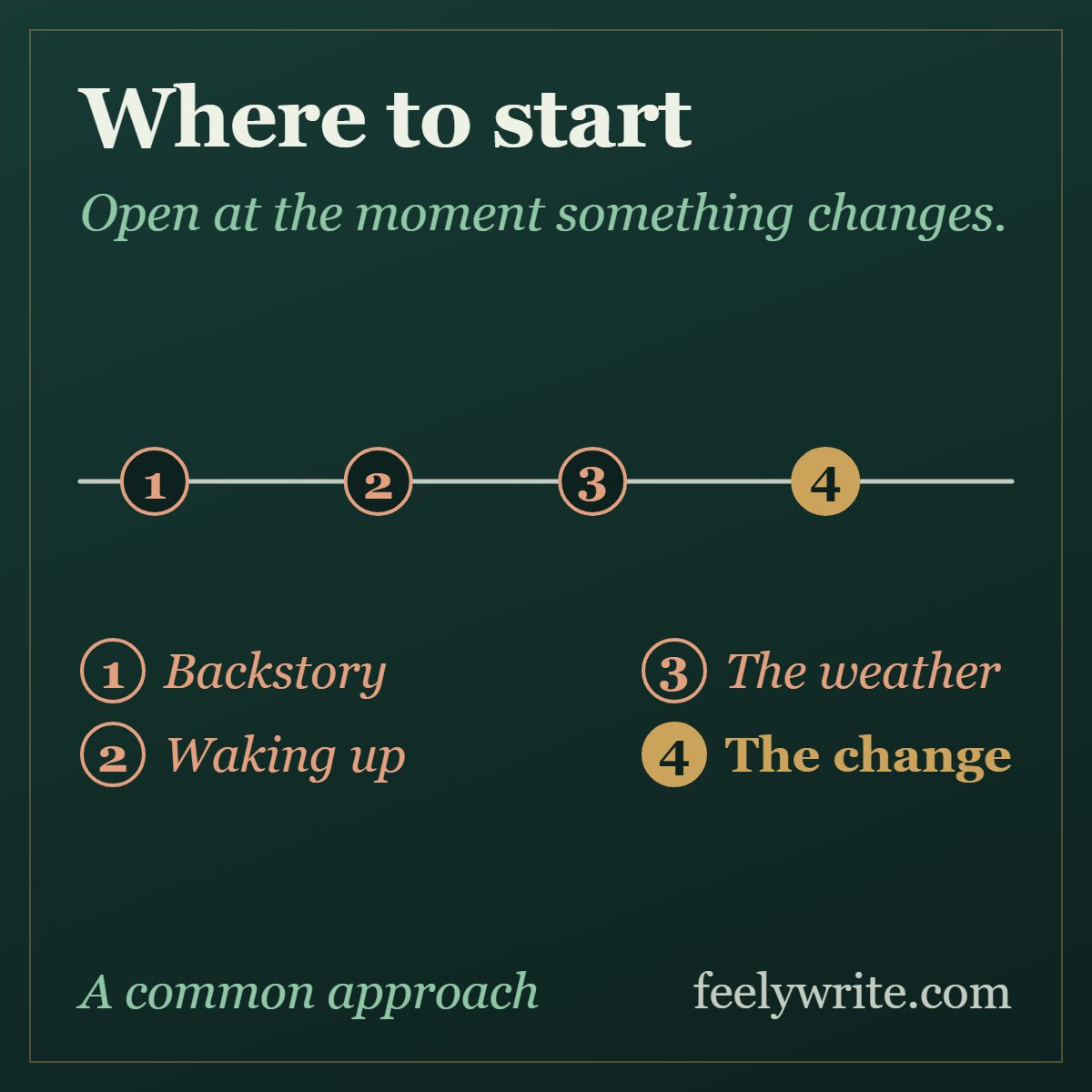
The two commonest failures are waking up and the weather. They fail for the same reason: nothing is happening yet and the reader is being asked to wait. The editors at Darling Axe put the first one bluntly: "Morning routines and literal wake-up calls rarely make for great reading" ([darlingaxe.com](https://darlingaxe.com/blogs/news/overused-openings)). Elmore Leonard made the second the first of his rules for writers: never open a book with weather.
An opening does not need action. It does need motion, which means somebody wanting something or noticing something that costs them. The other trap is explaining. A first page crowded with backstory is a writer reassuring themselves that the reader will understand. Readers are far more patient with confusion than with boredom.
What the story opening generator gives you
Tell the story starter generator your genre, point of view and tense, plus a few sentences about the story. You get ten first paragraphs, each starting on something concrete: an object, a gesture, a room, a line of dialogue. Each one comes with a note on the register it sets, so you can see why the fifth sounds colder than the second.
Read them for direction rather than sentences. The useful one is usually the opening line that points where you want the book to go, even if you rewrite every word of it.
Same opening, four ways
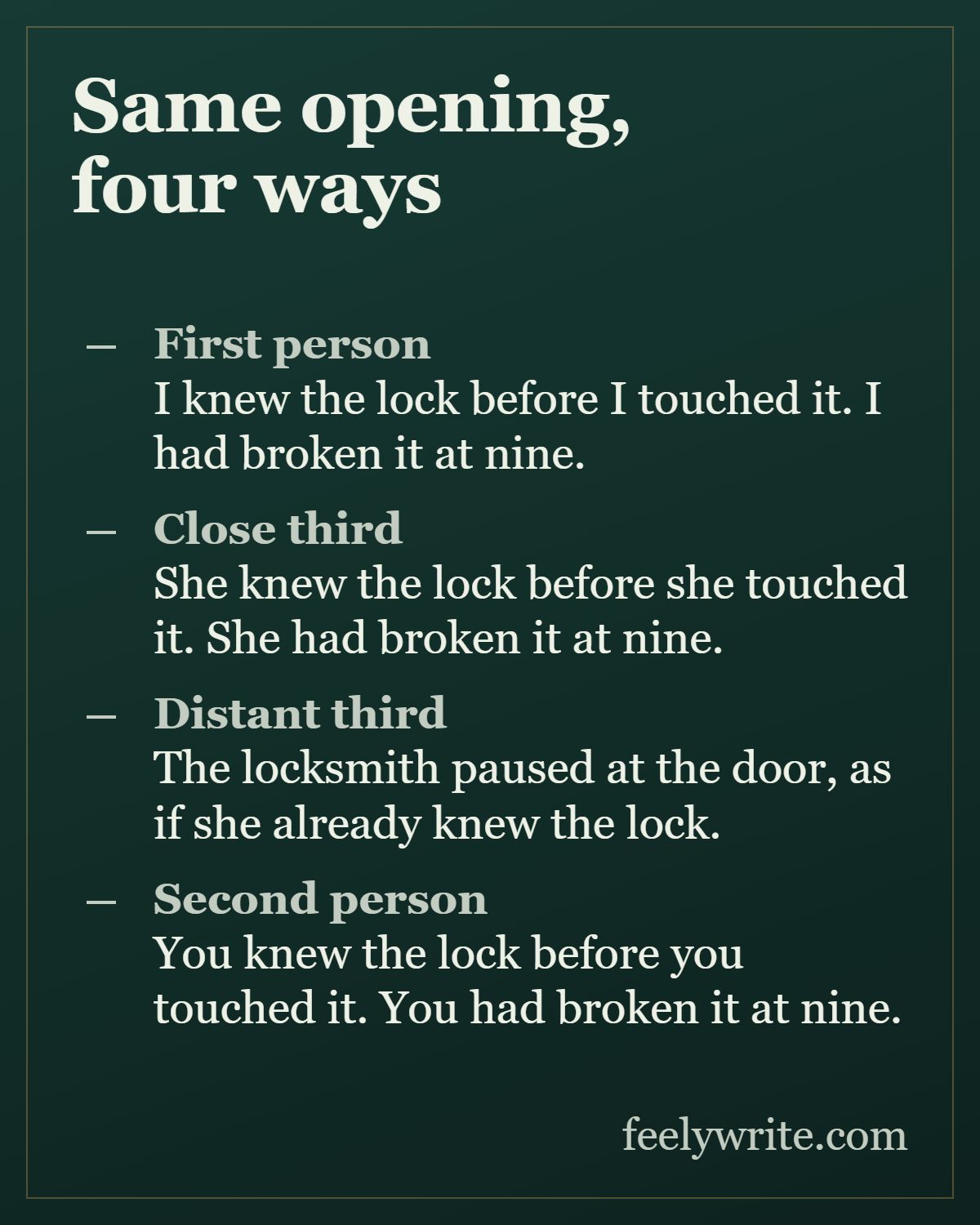
Point of view is a choice about distance, and the first line is where a reader measures it. Take a locksmith asked to open a door in a house she used to live in. In first person: "I knew the lock before I touched it. I had broken it at nine." In close third: "She knew the lock before she touched it. She had broken it at nine."
In distant third: "The locksmith paused at the door, as if she already knew the lock." In second person: "You knew the lock before you touched it. You had broken it at nine." The facts never change. What changes is how close the reader stands, so choose the distance you can hold for the whole book before you write the first line.
From opening line to chapter one
An opening is a promise the rest of the chapter has to keep. Pick the one you want, rewrite it in your own voice, then keep going. If you want help to continue the story, FeelyWrite does that part: list the beats of your first chapter and Draft writes each one as a scene in your point of view and tense. When you stall later, the studio can offer three ways forward instead of a blank page.
Start after the beginning
Write your opening, then delete the first paragraph and see whether anything was lost. Most of the time the second paragraph was the real start. The first was you clearing your throat.
Put one concrete thing in the first line
An object, a gesture, a smell, a specific room. Abstractions in a first line give a reader nothing to hold. The concrete detail is what makes them trust you enough to continue.
Set the contract on the first page
Tense, person, distance, tone: readers absorb all four immediately and feel cheated when they change. Whatever you choose, the first page should be an honest sample of the book.
Common questions
- Will these openings sound like me?
- Not yet. They are not meant to. Take the one that points where you want to go and rewrite it in your own voice. The value is the direction rather than the sentences.
- Is the story starter generator free?
- Sign up for a free account and you get 15 free credits, no card needed. Each run of ten openings spends one of them.
- Can I use a generated opening in a published book?
- You can use it. Most writers rework it heavily. On ownership, the US Copyright Office says: "Copyright does not extend to purely AI-generated material, or material where there is insufficient human control over the expressive elements" ([copyright.gov report](https://copyright.gov/ai/Copyright-and-Artificial-Intelligence-Part-2-Copyrightability-Report.pdf)). Its report explains how human rewriting and choices change that. For your own book, read it or ask a lawyer.
- Should I open with the weather or a character waking up?
- Usually not. Both are among the most common openings editors see. Both make the reader wait. If the weather is doing story work, such as a storm that traps the cast, it can open a book. Scenery alone rarely should.
- What point of view should I choose?
- Close third suits most commercial fiction. First person suits voice-driven stories. Present tense raises immediacy at the cost of flexibility. Try the same opening two ways and read both aloud.
- Can it continue a story I already started?
- This tool writes openings. To continue a story you have already started, use FeelyWrite itself: your characters and world go into Story DNA. Draft then writes the next scenes from the beats you give it.
Keep going from here
An opening is a door. FeelyWrite writes the next scene with you, in your voice, with your characters and world from Story DNA in view as it goes.
Start writing free