A character backstory generator for history that shows up now
Not a biography. A wound, the belief it left behind and the thing your character still does because of it, which is the part that reaches the page.
A character backstory generator builds a history for a character. This one returns a wound, the belief it created and the behavior that belief still drives, because those are the parts that change how a character acts on the page. Running it takes a free FeelyWrite account, which starts you off with 15 free credits.
Character backstory generator
Describe your character
Role, age and the shape of their wound in, ten backstories out.
0 / 2000
Backstory is only useful when it costs something now
Writers produce pages of history their readers never see. Most of it changes nothing. A childhood in a coastal town is a fact. A childhood in a coastal town that makes a character refuse to get into a boat, in chapter nine, in front of people whose respect she needs, is characterization. The difference is whether it produces behavior.
Give a character a history that produces behavior and they start making decisions you did not plan. That is the point at which a novel gets easier to write rather than harder.
The wound, the belief and the behavior
The useful chain is short. Something happened. It taught them something untrue but protective. They still act on it. K.M. Weiland, whose work on character arcs many novelists learn from, describes the character at the start of an arc this way: "He is harboring some deeply held misconception about either himself, the world, or, probably, both" ([helpingwritersbecomeauthors.com](https://www.helpingwritersbecomeauthors.com/character-arcs-2/)).
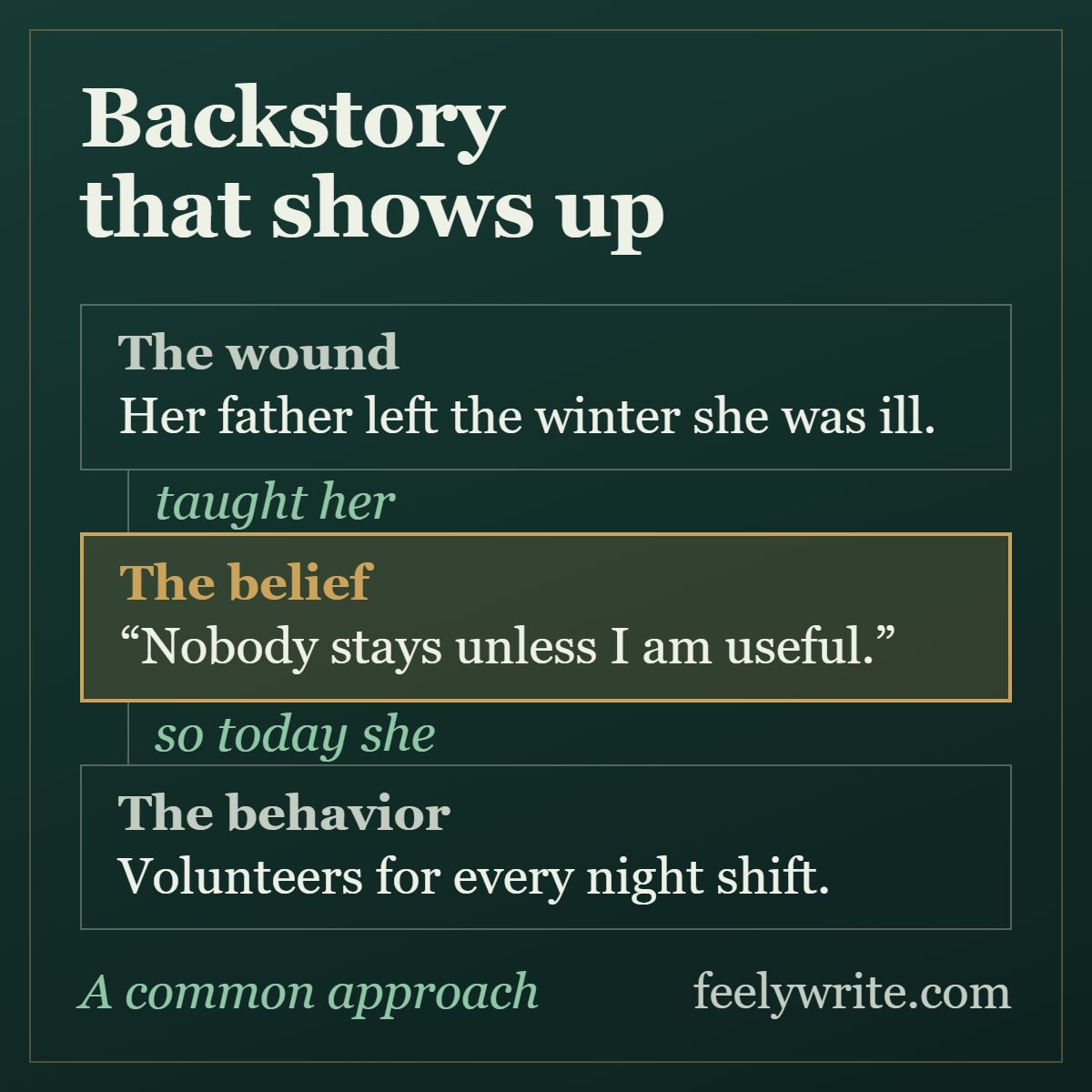
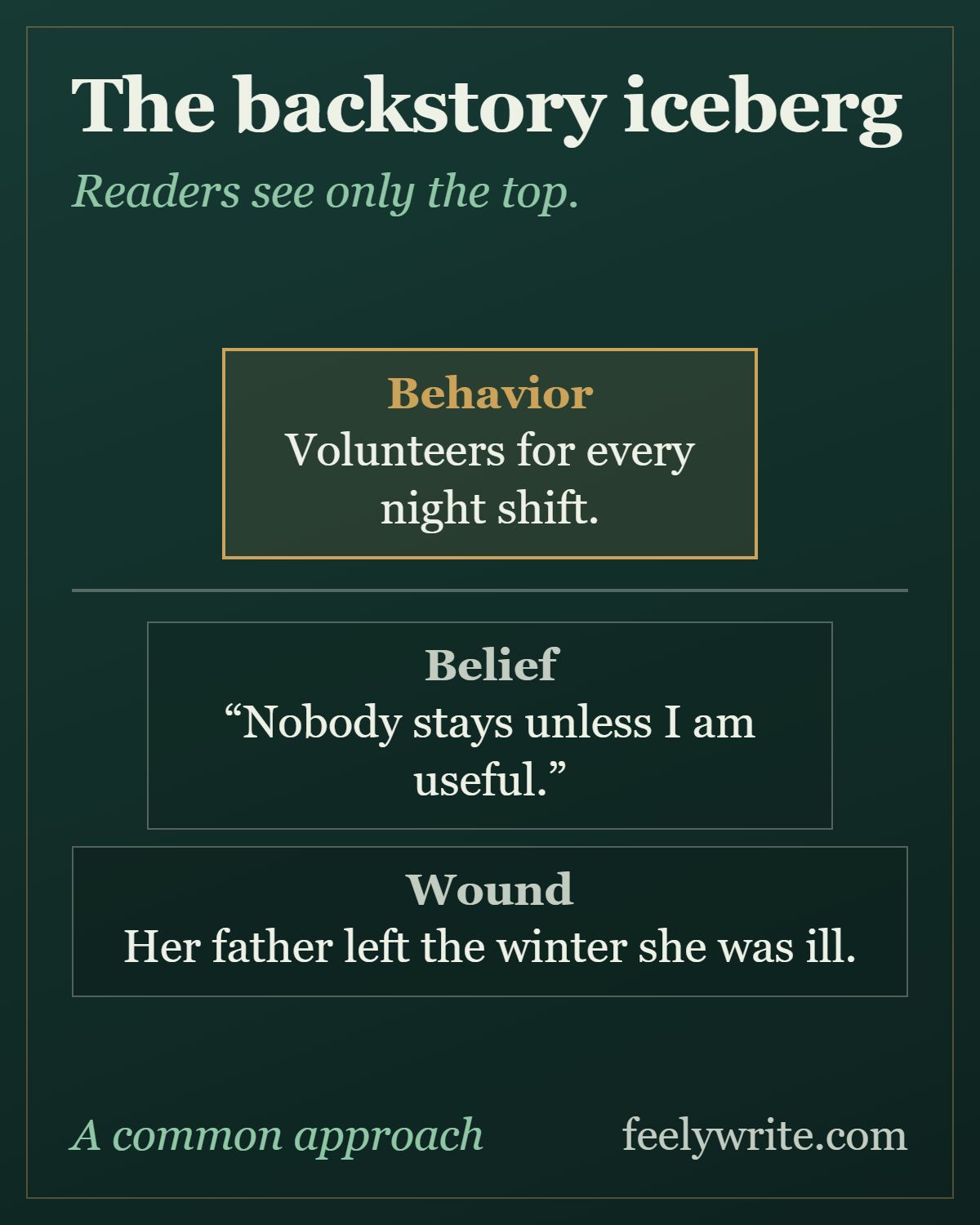
The wound explains the belief. The belief explains the behavior. The behavior is what the reader sees. The arc is the belief breaking. Every backstory this character backstory generator returns follows that chain, so each part leads to the next.
What the backstory generator gives you
Describe the character as they are now: their age, their job, the odd habit you noticed while drafting. The generator works backward to a wound, a belief and a behavior that fit, each stated in a sentence or two so you can use them rather than file them. Run it again for a different history, or keep the belief from one and the wound from another.
It is not a character description generator. It builds the past, not the face. Appearance belongs in the scene, where your point-of-view character notices it.
Keep the untrue belief in one sentence
If you need a paragraph, it is not a belief. It is a summary. "Nobody stays unless I am useful" is a sentence that will generate a hundred small decisions across a book without you thinking about it.
Show the behavior before the history
Readers enjoy working out why someone is like this. Give them the odd habit first and the reason much later. The reveal then lands as an answer, not an explanation they did not ask for.
Let the arc be the belief breaking
If you know what your character wrongly believes, you know what the ending has to cost them. The climax is usually the moment the protective belief is no longer available.
Common questions
- How much backstory does a character need?
- Enough that you know how they will react under pressure. That is usually one wound, one belief and two or three habits. It is very rarely a full biography.
- Should backstory go in the book?
- Mostly not directly. It should be visible in behavior, with the history itself surfacing in small pieces, late, only where the reader is already asking the question.
- What is a character wound?
- The event in the past that taught the character a false belief. It does not have to be dramatic. A parent who only praised results can leave a wound as deep as a war.
- Is the backstory generator free?
- Yes, on a free account. It comes with 15 free credits and no card. One backstory run takes one credit.
- Does it work for villains?
- Yes, and often better. A villain with a wound and a belief acts from a reason the reader can follow, even while hating the result. Pair it with the villain name generator when you need the name too.
- Can I keep these with my book?
- Yes. FeelyWrite keeps characters in Story DNA: who they are, what they want and how they change. Every feature reads it before it writes, so a character sounds like herself in chapter thirty. Talk to your book answers what she has admitted so far.
Put them in a scene
A backstory proves itself in behavior. FeelyWrite drafts the scene where it shows, with your character held in Story DNA every time they return.
Start writing free